moving stacks from the web editor to git
all my stacks used to live in portainer's web editor. the compose text existed in exactly one place, portainer's database, and the only backup was portainer's own backup. editing a stack meant editing production, no history, no review.
this is how i moved them to git.
portainer polls a git repo and redeploys a stack when the commit it is watching changes. each stack gets its own compose path and its own branch, and portainer remembers the last commit it deployed. default poll is five minutes.
assumes you have portainer on a swarm already.
Pre-reqs
- a git repo, private if your compose files describe your estate (mine does)
- portainer business or CE, both do git stacks
- shell access to a manager node
- somewhere to put secrets first, see secrets, do that page before this one if any stack has a password in it
1. lay the repo out one directory per stack
stacks/
  swarm/                      # the three node swarm
    adguard/compose.yml
    npm/compose.yml
    uptime-kuma/compose.yml
  pi-zwave01/                 # a standalone pi with the radios on it
    ser2net/compose.yml
    zigbee2mqtt/compose.yml
    zwave-js-ui/compose.yml
stacks/<env>/<stack>/compose.yml, and the <env> level is not optional. i had
a stack called watchtower on three different machines, without the env level
they collide. the directory name is also what the deploy branch and the renovate
PR title get named after, so make it readable.
the rest of the examples on this page use those six.
2. fix the compose files before you cut anything over
three things to fix while the stack is still running the old way.
all bind paths must be absolute. a relative ./data does not resolve on the
host, it resolves inside portainer's clone of your repo. the container starts,
finds an empty directory, reports itself healthy and writes there. if its a
database it initialises a new empty one.
i use an explicit local volume rather than bare bind syntax:
volumes:
  db:
    driver: local
    driver_opts:
      type: none
      device: "/mnt/docker-cephFS/wordpress_db"
      o: bind
reason for this approach: deleting the stack removes the volume definition but not the data at the device path. my nodes share replicated storage so a delete that took the data would take it from all three at once.
two things about it. the device directory has to exist before you deploy,
create it once on the shared storage; if it's missing the task fails to start,
leave it that way. and if a volume with the same name is already on a node,
docker reuses it and ignores driver_opts. after deploying, on the node running
the task:
it must show device, o and type. null or {} means the old volume was
reused, see troubleshooting.
pin the digest if you want the cutover to change nothing. no digest in the spec means a recreate re-pulls whatever the tag points at today, so your restart is also a version bump you didn't ask for.
check the repo file against what is actually running. my portainer database had been restored from backup at some point and several stacks in it did not match reality. the running container is the source of truth, not portainer's stored copy and not your new repo file. compare images and every bind and device path before you delete anything. two small scripts against the docker api were enough and they found real differences.
3. one branch per stack, not main
the obvious setup is point every stack at main. don't.
portainer compares the commit, not the file. twenty two stacks on main means
every commit to main redeploys all twenty two whether their compose changed or
not. fix a typo in a readme, restart the lot. mostly harmless, but not for a
database, and not for anything holding a serial device or a dns role.
so each stack points at its own branch:
deploy/swarm/adguard
deploy/swarm/npm
deploy/swarm/uptime-kuma
deploy/pi-zwave01/ser2net
deploy/pi-zwave01/zigbee2mqtt
deploy/pi-zwave01/zwave-js-ui
one branch per stack directory, same names. nobody commits to them directly, the
workflow in the next step moves them. change stacks/swarm/npm/compose.yml,
deploy/swarm/npm moves, npm redeploys, the other five don't notice.
the environment in the middle of the name is not decoration. the pi-zwave01
branches above are a standalone docker host, not the swarm: a raspberry pi
running the Portainer agent, holding the radios. see
the pi's stacks.
the repo layout, the branches and the workflow in the next step are the same for
it. the cutover in step 6 is not: that captures swarm
service state and waits out an overlay network, where a standalone host has
compose containers and neither. the compose files differ too, since a standalone
host honours container_name, restart and devices, which swarm ignores.
main is never deployed by anything. merging to main is a promotion, not a
deployment.
4. the workflow that moves the branches
.github/workflows/promote.yml. it works out which stack directories the push
touched and fast forwards those deploy branches. it never talks to portainer, it
only pushes refs, so it needs no credentials, no path to your lan and no self
hosted runner. portainer's polling does the rest.
name: promote

on:
  push:
    branches: [main]

permissions:
  contents: write        # the only permission needed

jobs:
  promote:
    runs-on: ubuntu-latest
    steps:
      - uses: actions/checkout@v5
        with:
          fetch-depth: 0        # needed, it diffs two commits

      - name: promote changed stacks
        env:
          BEFORE: ${{ github.event.before }}
          AFTER: ${{ github.sha }}
        run: |
          set -euo pipefail

          # a new branch or a force push leaves BEFORE unusable. promote nothing
          # rather than guess, the deploy branches keep serving what they have
          if [ "$BEFORE" = "0000000000000000000000000000000000000000" ] \
             || ! git cat-file -e "${BEFORE}^{commit}" 2>/dev/null; then
            echo "::warning::no usable before-SHA; promoting nothing"; exit 0
          fi

          changed="$(git diff --name-only "$BEFORE" "$AFTER")"
          [ -z "$changed" ] && { echo "nothing changed"; exit 0; }

          refs=""
          while IFS= read -r dir; do
            if printf '%s\n' "$changed" | grep -q "^${dir}/"; then
              branch="deploy/${dir#stacks/}"
              refs="${refs} ${AFTER}:refs/heads/${branch}"
              echo "  $dir -> $branch"
            fi
          done < <(find stacks -mindepth 2 -maxdepth 2 -type d | sort)

          [ -z "$refs" ] && { echo "no stack dirs changed"; exit 0; }

          # ONE push, all refs, --atomic. a plain multi ref push is NOT all or
          # nothing: refuse one ref and the others still land
          git push --atomic origin $refs
find stacks -mindepth 2 -maxdepth 2 -type d is what makes it generic, it picks
up stacks/<env>/<stack> and nothing else, so adding a stack needs no edit here.
add the directory, create its deploy branch, point portainer at it.
deleting a stack directory retires nothing. the find only sees directories
that still exist, so if a commit deletes stacks/swarm/adguard/ the workflow
matches nothing, promotes nothing, and prints "no stack directories changed" even
though a stack file clearly did change. deploy/swarm/adguard stays where it is
and portainer carries on serving the last commit it saw, indefinitely.
promoting the deletion would not help either, portainer would just fetch a commit with no compose file at the configured path and error. retiring a stack is a manual sequence and worth writing on your own runbook:
- delete the stack in portainer
- delete
deploy/<env>/<stack>— which the ruleset blocks, so this needs the break-glass in step 7 - then remove the directory from git
renaming has the mirror problem: the new directory looks like a change so the
push creates deploy/<env>/<newname>, which nothing polls, and the old branch is
left stale.
--atomic is not optional. i first wrote this as a plain git push with
several refs and told myself that was all or nothing. it isn't. refuse one ref,
say a deploy branch is somehow non fast forward, and the others still land, so a
commit touching two stacks gets half of itself into production and then reports
failure, which reads like nothing happened. with --atomic either every branch
moves or none do.
easy to check against a local bare repo with an update hook that refuses one
ref. without the flag the survivor shows * [new branch], with it both report
atomic push failure and the remote is untouched. use an update hook not
pre-receive, exiting non zero in pre-receive rejects the whole push either
way and makes a non atomic push look atomic.
worked example, a commit that edits stacks/swarm/npm/compose.yml and
stacks/pi-zwave01/ser2net/compose.yml and a readme:
two branches move, four don't, the readme moves nothing.
5. protect the deploy branches (and check it actually applies)
block force pushes and deletions on deploy/* so a deploy branch can only ever
move forward, onto a commit that passed ci. that makes rollback a revert rather
than a rewrite, see step 7.
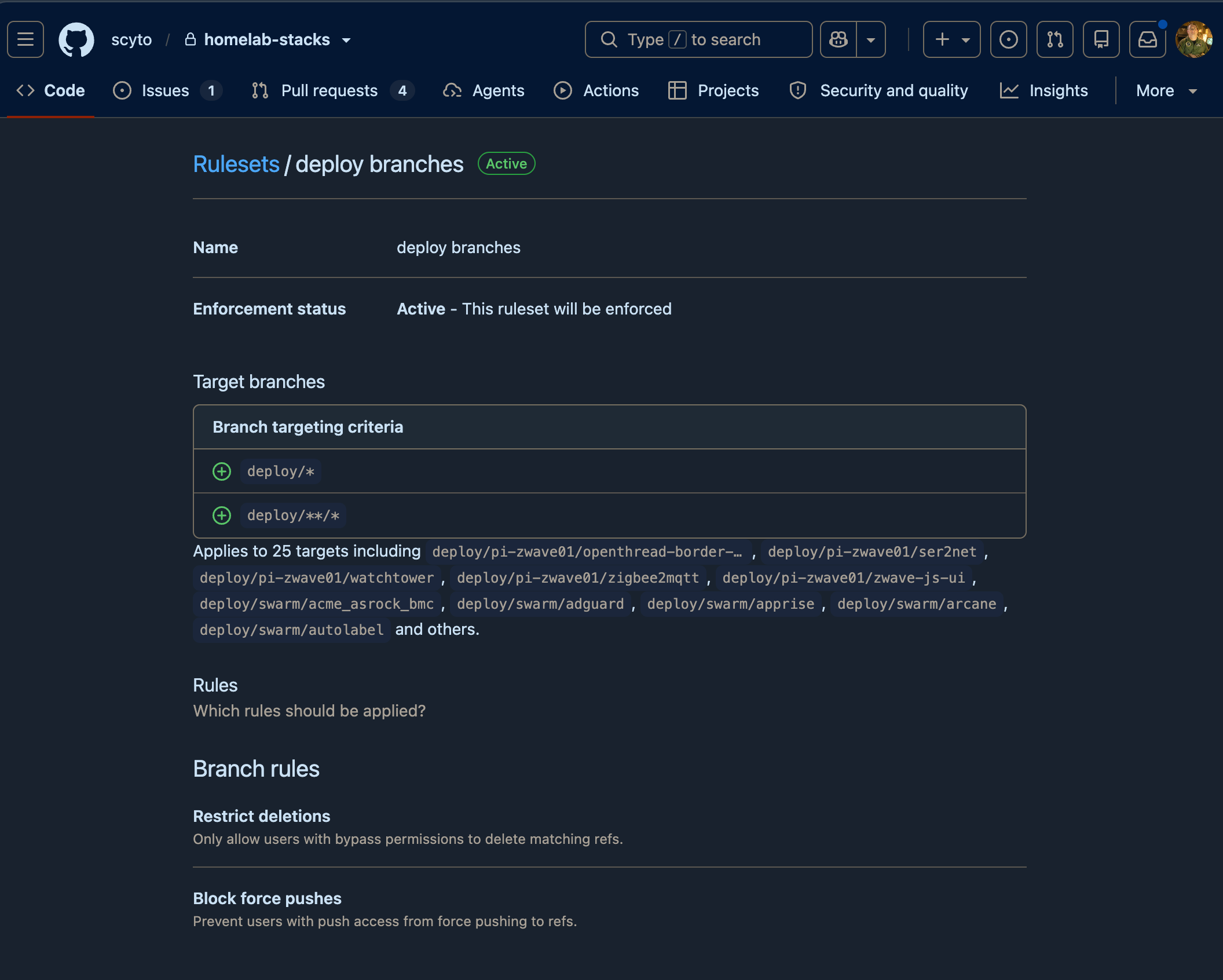
the trap: a ruleset targeting deploy/** matches nothing, because of how
github's ** matching works. it shows as active and enforces nothing at all. you
need both patterns:
that is what you type in the UI. the API stores them prefixed as
refs/heads/deploy/*, so don't be thrown when gh api repos/<owner>/<repo>/rulesets/<id>
reads back differently to what you entered.
green status is not proof. the useful tell is the applies to N targets line under the patterns: if that reads 0, or fewer than you have deploy branches, the pattern is wrong however active the ruleset says it is. then try to push something the rule should forbid and confirm you get refused.
the rules for main itself, require a PR and require your ci check, are worth
doing once renovate is opening PRs, see
image updates with renovate.
6. cut a stack over
this is a delete and recreate, not an edit. portainer always deploys on create.
before you touch anything, capture what is running so you can diff after:
docker stack ls --format '{{.Name}}' | while read s; do
  docker service inspect $(docker stack services -q "$s") > "/tmp/pre-gitops-$s.json"
done
then per stack:
- confirm the hardware is present if the stack needs it,
ls -l /dev/serial/by-id/ - confirm every secret and config the compose references already exists
- note the exact stack name, you must reuse it, service dns is
<stack>_<service> - delete the stack in portainer
- wait for the overlay network to actually go away, see below
-
Stacks > Add stack > same name > Git repository, then
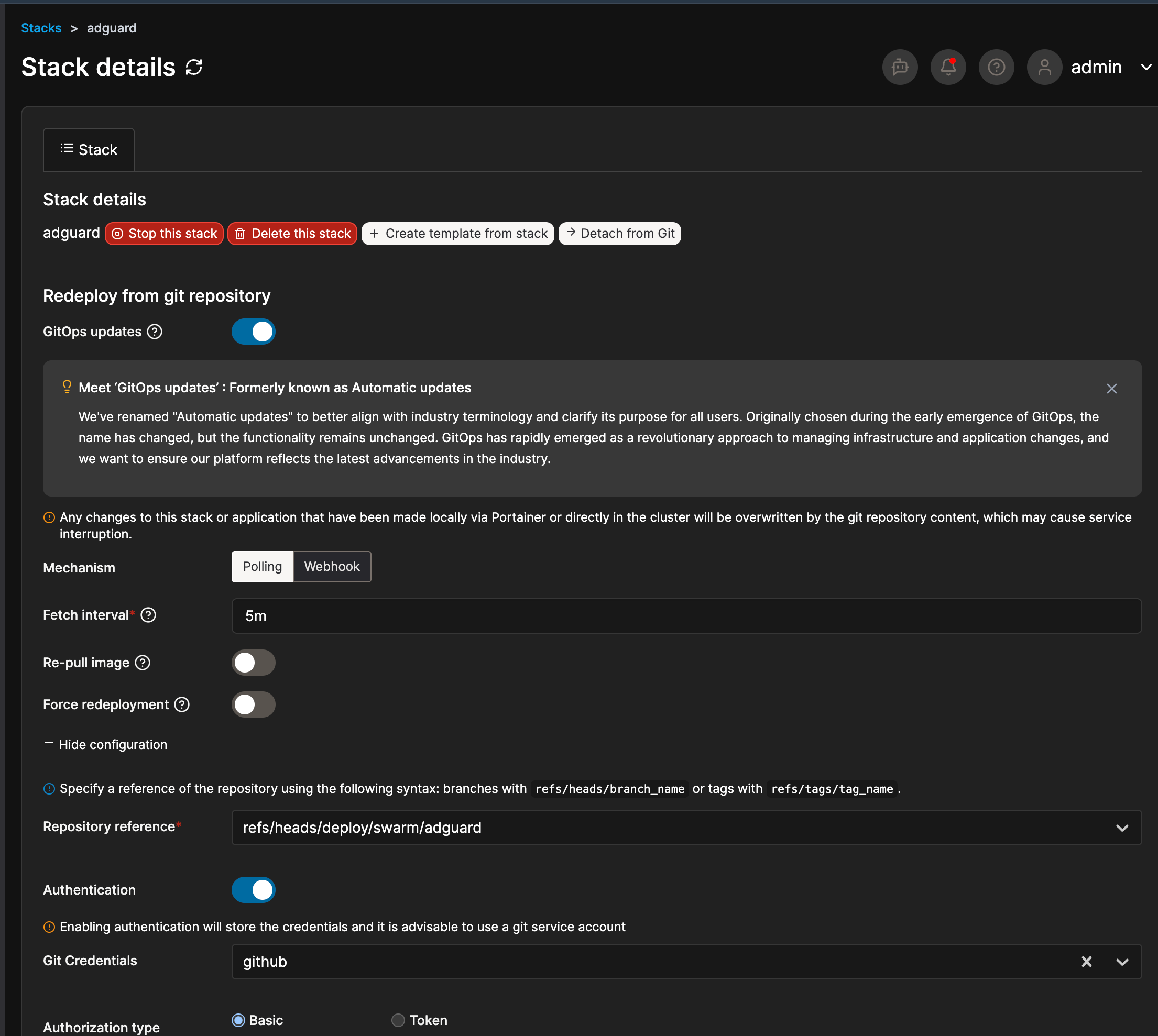
field value, for adguard Repository URL your repo Repository reference refs/heads/deploy/swarm/adguardCompose path stacks/swarm/adguard/compose.ymlGitOps updates on, polling, 5m the reference dropdown lists every ref on the repo, including a
refs/pull/<n>/headfor every PR ever opened, and github never removes them. type part of the branch name to filter it. it starts onrefs/heads/main, so check it again just before you deploy. never pick arefs/pullref, it can be a commit nobody reviewed and your ruleset doesn't cover it -
diff
docker service inspectagainst the capture you took above
the same fields on a stack that is already git backed, so you can see what it
looks like once it is working. note Re-pull image and Force redeployment are
both off: renovate changes the tag in git, so portainer has nothing to
re-pull behind your back.
7. rolling back a compose
deploy branches are fast forward only, so a rollback is not a force push. its
a revert on main that gets promoted forward like any other change:
git checkout -b revert/npm-bad-change
git revert <bad-sha>              # or just edit the file back by hand
git push origin revert/npm-bad-change
gh pr create --fill && gh pr merge --rebase
promote moves deploy/swarm/npm forward to the revert and portainer picks it up
on the next poll, so under five minutes from merge.
i chose this over allowing force push rollbacks because the audit trail survives, the revert commit records why, and the deploy branches keep the property that they only ever point at a commit that passed ci.
the cost is speed, and its slower exactly when you want it to be fast. a revert still needs a PR and a ci run. if something is actually broken right now:
- stop the stack in portainer. instant, stops the bleeding, do the proper revert after
- roll forward if the fault is obvious and small
- break glass, suspend the ruleset, force push, put it back:
gh api repos/<owner>/<repo>/rulesets                       # get the id
gh api -X PUT repos/<owner>/<repo>/rulesets/<id> -F enforcement=disabled
# force push the rollback, then IMMEDIATELY
gh api -X PUT repos/<owner>/<repo>/rulesets/<id> -F enforcement=active
a disabled ruleset nobody re-enables is worse than never having had one.
a compose revert is not a data revert. reverting the image tag on something that ran a schema migration on startup gets you the old binary against the new schema. for databases, take the backup before you merge the bump, not after.
traps
- check hardware is present before cutting over a device dependent stack.
create always deploys, and if the deploy fails the rollback fails the same way
and the stack record is gone. i lost my
zigbee2mqttstack this way, dongle wasn't plugged in. cost me a rebuild because the compose was already in git, had it only been in the web editor it was gone - deleting a stack races its own overlay network.
<name>_defaulttakes a moment to tear down and recreating too fast fails on a network that still exists while being deleted. the rollback hits the same race. wait for it:
- a stopped stack stops tracking git entirely. portainer doesn't poll stopped stacks, so they sit at their last deployed commit and fall behind while looking fine in the stack list
- external stuff isn't in the compose. my adguard macvlan networks are
external: truedeliberately so deleting a stack can't destroy them, but that means git can't recreate them either. keep a script. config-only networks are per node and must exist on every node before the swarm scoped one can be created on a manager, order matters - same goes for node labels if you use placement constraints. mine are generated by a labelling container so they rebuild themselves, a hand applied label exists nowhere but the raft log
- comment only changes are free on a standalone host, compose compares the resolved config. on swarm the file hash changes and the stack updates, so the behaviour differs
next
image updates with renovate, which is the reason to do any of this.